
Putting one foot in front of the other is effortless for many of us, an act often taken for granted. For those with physical, cognitive, or visual impairments, walking can be a significant challenge, a complex negotiation of spaces not designed for their needs. Artists Jason DaSilva, Carmen Papalia, and Sunaura Taylor explore the aesthetic and conceptual implications of walking with a disability, compelling us to rethink the presumed simplicity of ambulation and prompting reflection on the lack of support and resources for those with disabilities. This analysis delves into how “disability aesthetics” redefines beauty and function, serving as a critical lens for evaluating societal inclusivity. Disabled artists revolutionize perceptions of disability by offering authentic representation, advocating for visibility, challenging stereotypes, and fostering community solidarity.1 Their work opens conversations about societal norms, encourages viewers to question assumptions, and presents diverse interpretations of disability. These artists emphasize the importance of empathy, understanding, and acceptance, which are crucial for social advancement and knowledge generation.4 Through his work, Papalia seeks to interrupt the status quo and complicate spaces by championing people to reassess their ideas about disability and accessibility.
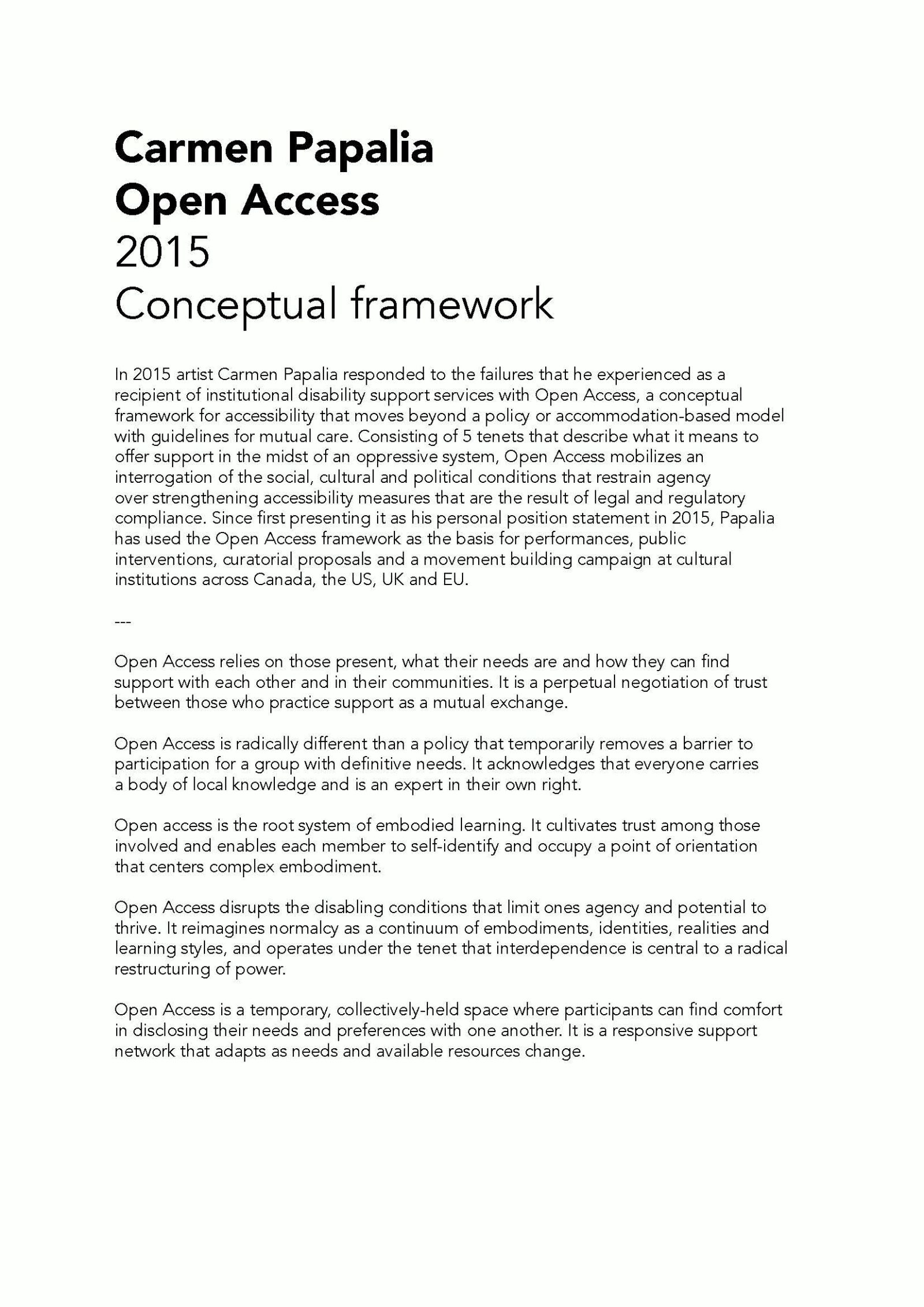
Open Access (Figure 9) is a multifaceted project that serves as a manifesto, agreement, and advocacy platform.5 This project provides a universal support framework for various issues and experiences fitting under the rubric of disability, offering an expanded model that counters the prevailing impression of disabled people partaking in a singular state of participation.6 It departs from the regulatory paradigm usually employed by public institutions and promotes agency and power across social, cultural, and political boundaries.10 Further, Papalia wants to give the disabled person agency over their movement experience, which he felt in his case had been diminished by the cane. Using the music in a group setting allows others to understand how a non-visual person navigates and negotiates.
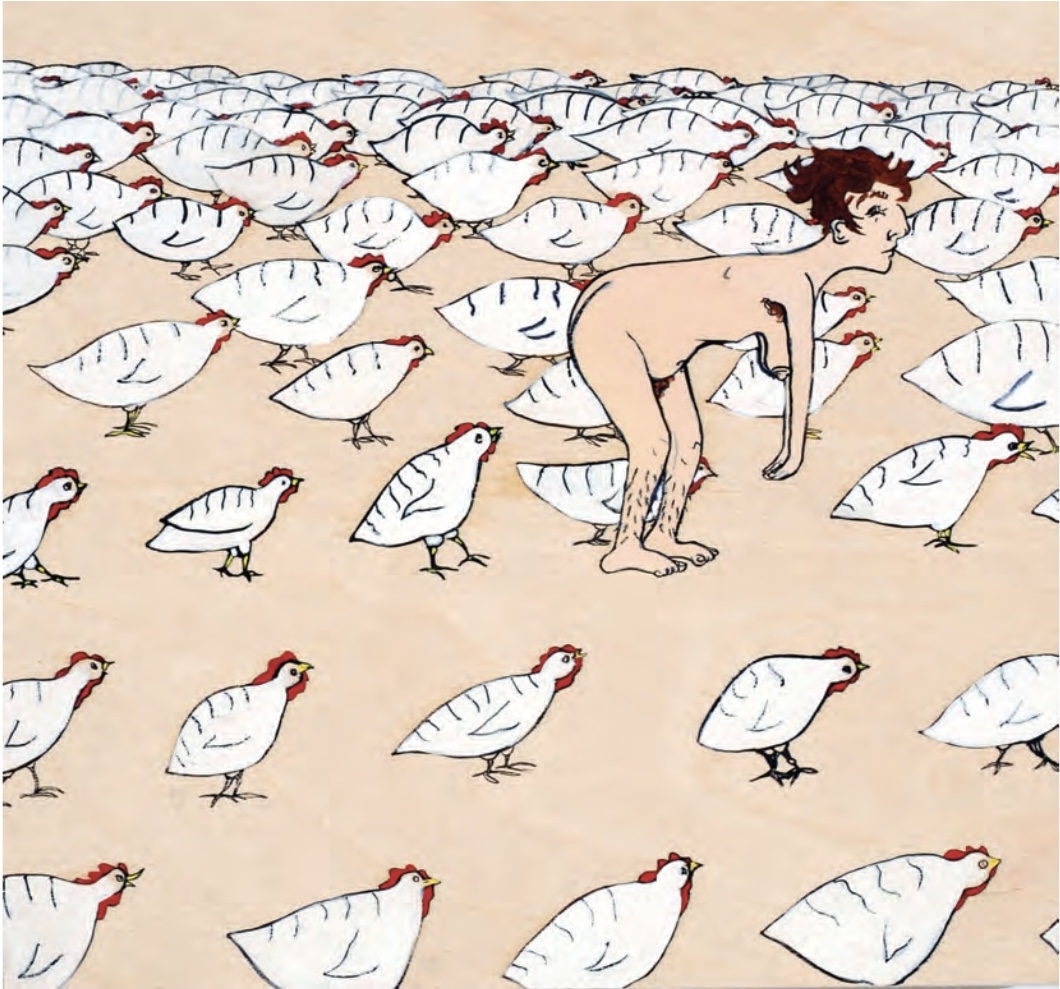
Sunaura Taylor interweaves themes of disability and animal rights informed by her autobiography. Born with arthrogryposis—a neuromuscular condition caused by exposure to trichloroethylene-contaminated water—Taylor faces significant physical challenges.12
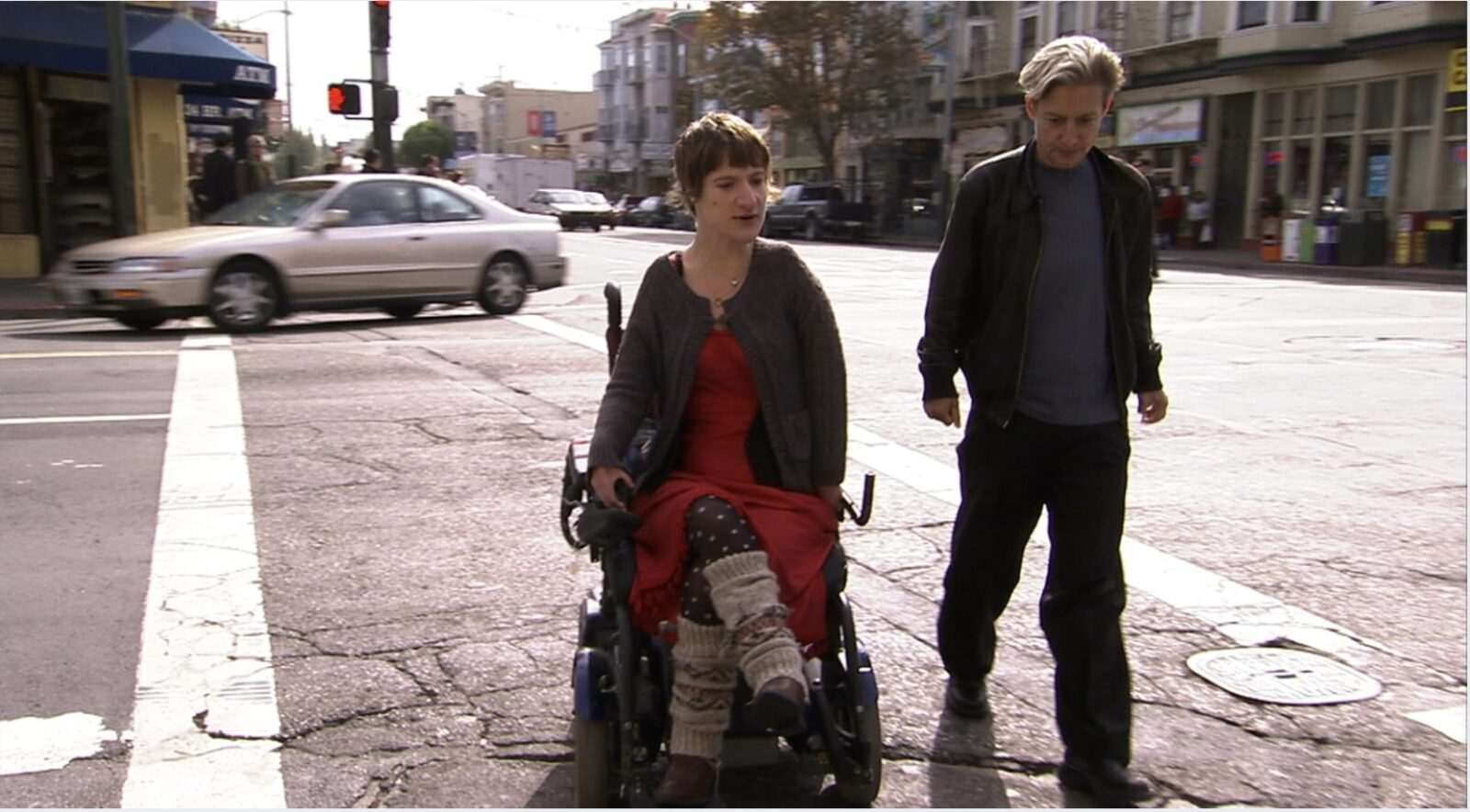
In the documentary film Examined Life of 2008 (88 min.) (Figure 13), directed by her sister Astra Taylor, Sunaura Taylor drives her motorized wheelchair and the post-structuralist philosopher Judith Butler walks beside her through the streets of San Francisco, discussing the construction of spaces and bodies and the characterization of some bodies as “normal” and others as disabled. Taylor answers Butler’s question about how she takes walks and takes strolls:
Well, I think I always go for a walk, probably every day I go for a walk, and I always tell people I’m going for walks—I use that word even though I can’t physically walk. I mean, to me, I think the experience of going for a walk is probably very similar to anybody else’s: it’s a clearing of the mind, it’s enjoying whatever I’m walking past. And my body is very involved even though I’m physically not walking. I have my own ways in which I engage my body, my balancing. But yeah, I use that term: walking. And most of the disabled people that I know use that term also.13
Taylor’s walk with Butler is apposite. Like DaSilva and Papalia, her project deals with the body and its acculturation in complex layers. Butler has argued that one putatively “biological” identity marker, gender, is a cultural performance shaped by social rituals and institutional power. The act of “doing”—and how that doing is culturally perceptible and acknowledged (or disavowed) —shapes how society ascribes masculinity or femininity to bodies, subject to societal normalization. Like gender, “ability” is not a biological entity but a cultural construction. Taylor’s reflections on her embodied experiences highlight how such constructions shape and transform how we use our bodies. Taylor’s graphic work and her collaboration with Butler in these examples from her oeuvre delve into disability, animal rights, and social exploitation. They call into question societal constructions of the body and identity, providing a powerful critique of the normalization of ableism and exposing the interconnections between different forms of oppression.
These “walking” works offer valuable insights into the experiences and perspectives of disabled artists. By exploring everyday walking activities and their hassles or vexations for individuals with disabilities, these artists reveal how simple tasks can morph into intricate and demanding experiences. Embracing disability as a unique aspect of their identities, these artists see, hear, contemplate, and articulate approaches to making the art world more inclusive in representing and accommodating bodies. These artists disaffirm expectations through their art, emphasizing the worth of openness and accessibility. Their works also highlight walking as a form of self-expression and liberation for disabled individuals. Often seen as a simple everyday activity, walking takes on a new meaning in the context of disability, becoming a symbol of resilience, agency, and self-determination. DaSilva, Papalia, and Taylor remind us that disability is not just a medical condition but a complex social and cultural construct that profoundly impacts individuals’ lives.14
By presenting walking through the lens of disability, these artists ameliorate a routine undertaking into a profound expression of resilience and autonomy, motivating us to confront our preconceptions, reassess societal norms, and envision a society that genuinely accommodates and celebrates all its members. The groundbreaking work of artists like Jason DaSilva, Carmen Papalia, and Sunaura Taylor opens consequential dialogues around disability, accessibility, and the multifaceted experiences of navigating the world with bodily impairments. Their art not only dares us to question how societal structures and policies impact the lives of those with disabilities but also raises valid questions about the intersection of disability with other marginalized identities, the role of art in influencing policy and attitudes, and how the art world can better amplify the voices and experiences of disabled artists. The ongoing dialogue sparked by these artists serves as a decisive reminder of the transformative potential of disability aesthetics—not only in reshaping our awareness but in catalyzing tangible, lasting change. The path forward demands a collective commitment to listening, learning, and acting, guided by the visionary leadership of artists like DaSilva, Papalia, and Taylor, who invite us to imagine a more just and inclusive world. We must remember the urgency of advocating for accessible locations to achieve walking with relative ease and comfort.
: :
Endnotes
- Sue Cheesman, “Ten Years of Touch Compass Dance Company’s integrated education programme under the spotlight: A reflective essay,” The Routledge Handbook of Disability Arts, Culture, and Media, edited by Bree Hadley and Donna McDonald (New York: NY: Routledge, 2019): 114.
- Eliza Chandler, Megan Johnson, Becky Gold, Carla Rice, and Alex Bulmer, “Cripistemologies in the City: ‘Walking-Together’ as Sense-Making,” Journal of Public Pedagogies, guest edited by WalkingLab, no. 4 (2019), http://jpp.vu.edu.au/.
- Jason DaSilva, “Opinion: The Disability Trap,” The New York Times (July 24, 2018), https://www.nytimes.com/2018/07/24/opinion/disability-trap-state-medicaid.html.
- “A Temporary, Collectively-Held Space: A conversation between Amanda Cachia and guest-editor Carmen Papalia,” BlackFlash, vol. 38, no. 2 (2021): 19.
- For information about the many forms of Open Access, see Carmen Papalia, “Open Access,” Carmen Papalia, August 21, 2015, https://carmenpapalia.com/2015/08/21/open-access/ and Cachia and Papalia, BlackFlash, 2021.
- Catalin Brylla and Helen Hughes, “Introduction: The Bricolage of Documentary and Disability,” Documentary and Disability, edited by Catalin Brylla and Helen Hughes (New York: Palgrave MacMillan, 2017): 5.
- Carmen Papalia, “An Accessibility Manifesto for the Arts,” CanadianArt (January 2, 2018), https://canadianart.ca/features/access-revived/.
- Carmen Papalia, “A new model for access in the museum,” Disability Studies Quarterly, 33(3) (2013), http://dsq-sds.org/article/view/3757/3280.
- High Line Art, Mobility Device: Carmen Papalia, August 28, 2019, https://fhl-website.s3.amazonaws.com/content/uploads/2019/08/28132450/HL_PressRelease_CarmenPapalia_2019.pdf. (There is a short interview video available connected to this performance, available at https://www.youtube.com/watch?v=UINvEeRM-Kw.)
- Carmen Papalia, “You Can Do It With Your Eyes Closed,” art21 magazine (September/October 2014), October 7, 2014, https://magazine.art21.org/2014/10/07/you-can-do-it-with-your-eyes-closed/.
- Astra Taylor and Sunaura Taylor, “Military Waste in Our Drinking Water,” AlterNet, August 4, 2006, https://www.alternet.org/2006/08/military_waste_in_our_drinking_water.
- Sunaura Taylor, Beasts of Burden: Animal and Disability Liberation (New York: The New Press, 2017): 38-9.
- Butler and Taylor, Examined Life, 186.
- As Gretchen E. Henderson notably remarked, “Disability metaphors sometimes make abstract ideology into an embodied form that must carry symbolic value, obscuring the fact that disabled bodies live complex lives and carry rich and varied knowledges that can restructure not only culture but also narrative.” (cf. Gretchen E. Henderson, “Sharing and shaping space: Notes towards an aesthetic ecology,” Interdisciplinary approaches to disability: Looking Towards the Future, volume 2, edited by Katie Ellis, Rosemarie Garland-Thomson, Mike Kent, and Rachel Robertson (New York: Routledge, 2019): 67.
Anne Swartz