“The journey of a thousand miles begins with a single step.”
– Lao Tzu, Tao Te Ching (6th century BCE)1
This essay presents a journey of walking as intrinsic to artistic interventions and performances that transcend the boundaries between virtual and physical spaces while engaging with complex socio-political issues; showcasing a progression of artistic interventions that traverse digital, physical, and conceptual landscapes, step by step, provoking critical discourse and collective action towards social and environmental justice.
: :
dead-in-iraq
“America’s Army” (2002–2022) was a highly popular online video game/recruiting platform funded by the US Department of Defence to entice young people to join the US military. My journey into this online war-simulator, commenced in March 2006, aligning with the third anniversary of the start of the US’s invasion of Iraq. Entering the game with the avatar callsign of “dead-in-iraq,” I would join my platoon of other players, immediately drop my weapon, walk 50 yards or so into the simulated Middle Eastern war zone, stand still, and type, using the game’s text messaging system: the name, age, service branch, and date of death of each documented US casualty from the then ongoing war in Iraq. My message appeared on the screens of other players in the match, e.g., “[US Army] dead-in-iraq messaged: JASON J CORBETT 23 ARMY JAN 15 2007”.
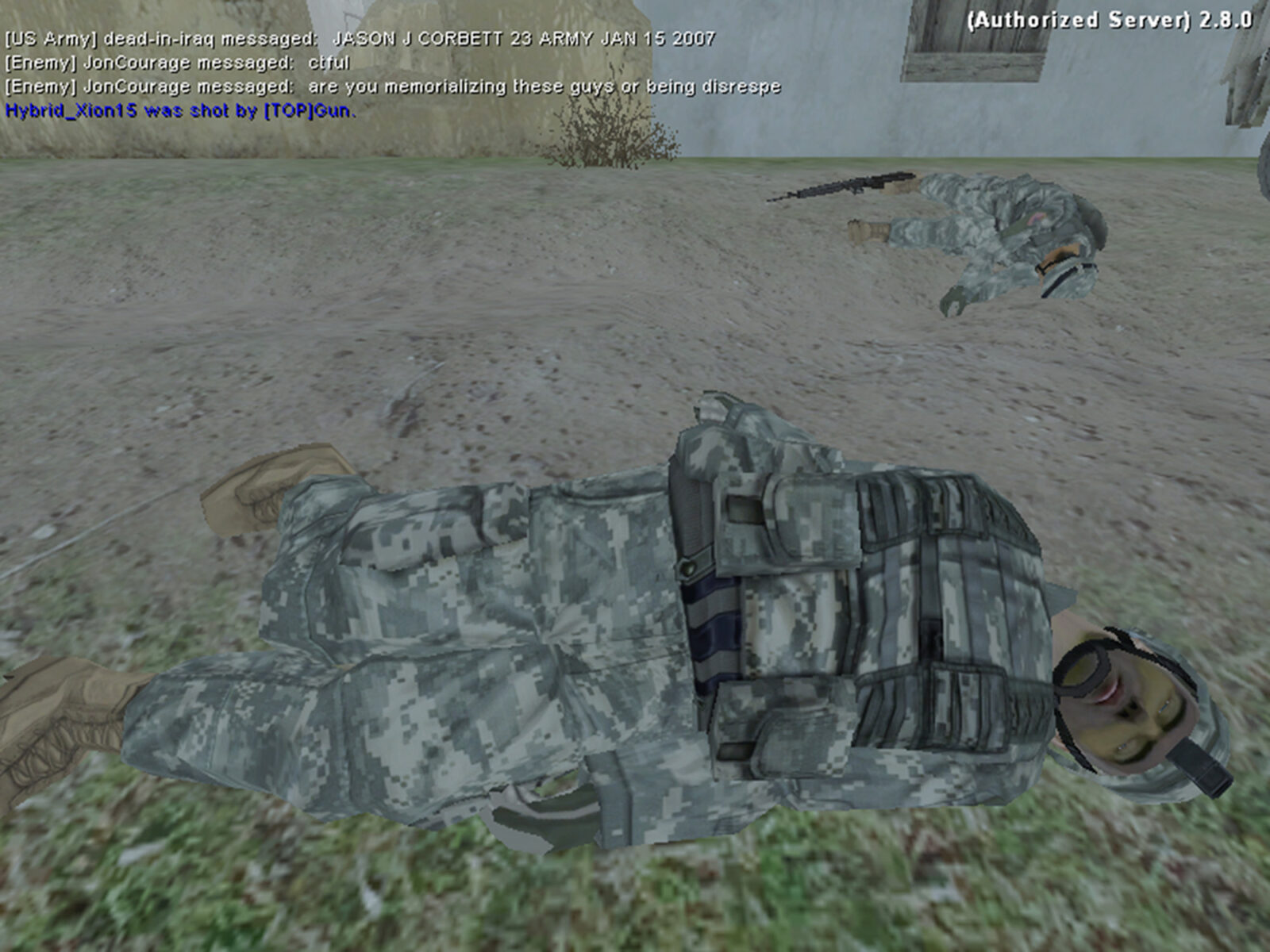
When my avatar was killed, I continued to type while hovering over my virtual corpse. Upon respawn in the subsequent round, I resumed the cycle. This work was not just a protest but also a virtual memorial set within the dynamic environment of real-life gaming. It delves into the intricate relationship and blurred boundaries between gaming and the realms of military recruitment, death, memorialization, protest in the digital age, and the grim realities of warfare. Walking briefly into this game space in order to stand still without a weapon and await the death of my avatar was a core element of the intervention.
: :
Gandhi’s March to Dandi in Second Life
“dead-in-iraq” received widespread media attention, including a live interview on CNN. I often found myself responding to what were highly negative attacks questioning my actions. In early 2007, in one exchange with a detractor in a comments section from an article online, amidst a spirited defence of dead-in-iraq, he declared, “Dude! You’ve got a Gandhi complex.” While I found it striking that someone would think that being like Gandhi was some kind of psychological illness, this interaction sparked an idea that became my first deep engagement with walking in my creative practice.
This accusation became a catalyst for a new performance wherein I would become Mahatma Gandhi in an online game space, and walk as a form of performative re-enactment. It took some time for me to fully embrace this concept—I was quite nervous regarding the larger implications of me, a middle-aged white male, becoming Gandhi. Second Life, however, surrounded itself with marketing materials and a general zeitgeist that your second self, your avatar, was only limited by your imagination—their virtual world was a playground for exploring alternate, fantasy selves. I thought, okay, why not Gandhi? Like many historical figures, the myth surrounding Gandhi, has, in recent years, been re-evaluated—yet he remains a pivotal figure in the history of protest and arguably his performative transformation from solicitor to loin-cloth wearing pacifist was a highly effective and worthy of creative exploration in this context. In the summer of 2007 on a residency to the Banff New Media Institute, I had the opportunity to meet and work with curator Sarat Maharaj. Later that year in London, we met for lunch—I described to him the interaction where I had been accused of “having a Gandhi complex”. Sarat listened to my concerns and was supportive of my feeling that it was something that I should do. I moved forward to bring this idea to fruition.
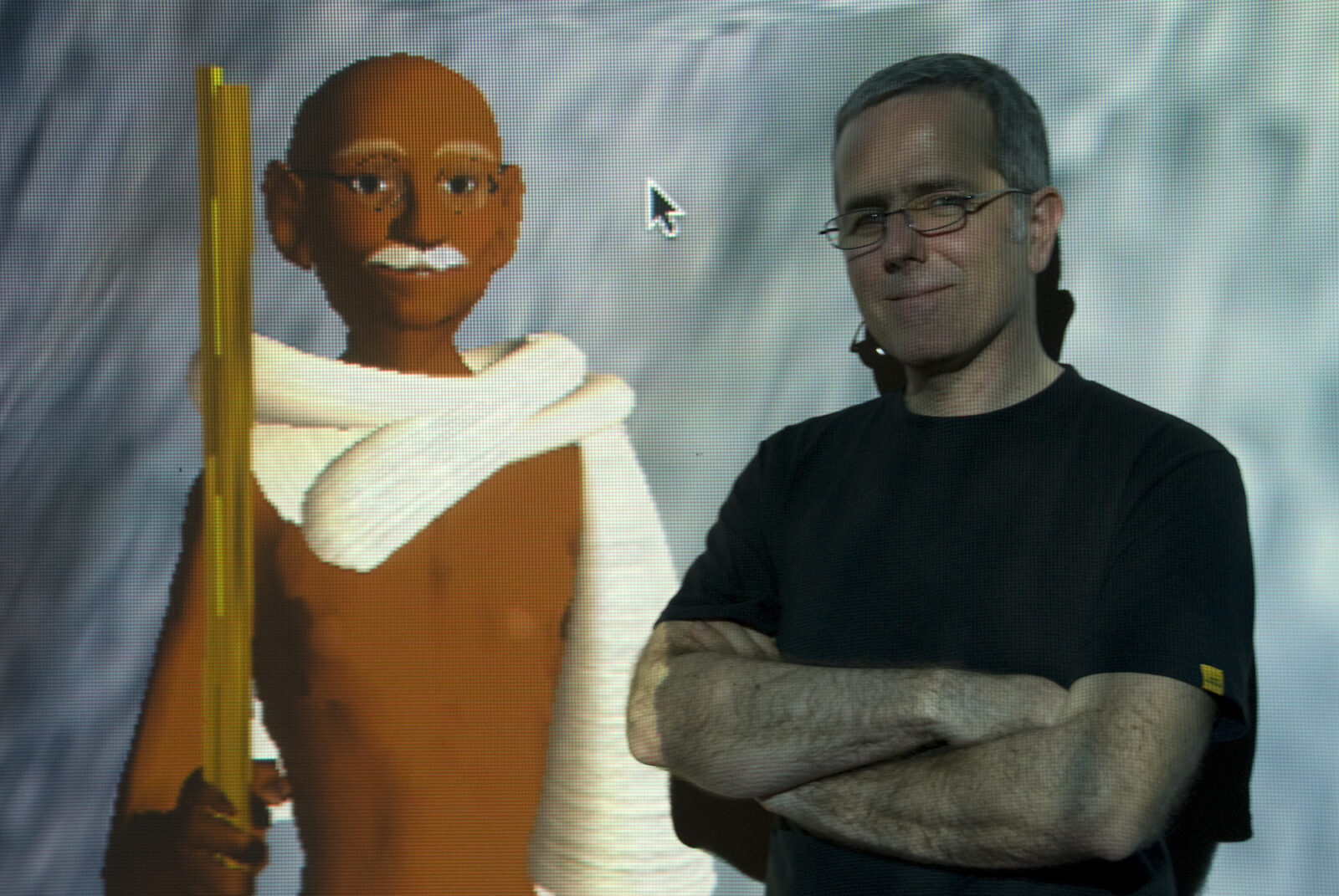
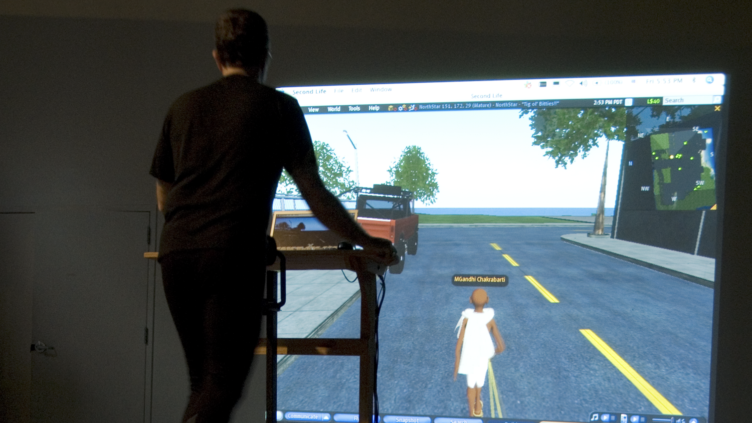
“The Salt Satyagraha Online—Gandhi’s March to Dandi in Second Life” expanded upon my previous online text-based performances within online games. The notion of walking within game spaces had been on my mind for some time. Gandhi’s peaceful protest known as the Salt March, as outlined his autobiography excited me as something that could potentially serve as the basis for a powerful and thought-provoking re-enactment.2 In developing the Gandhi performance, I chose to engage in the then nascent online community of Second Life (SL). I further expanded the concept of walking in a virtual space by bringing the act into the real world, utilizing an adapted Nordic Trac “Walkfit Treadmill” as my game controller: thus my steps on the treadmill became my steps as Gandhi in the online world.
Over 26 days, which matched the actual days of the original march, albeit 78 years after Gandhi’s 1930 march, I physically and virtually re-enacted Gandhi’s historic journey, covering in total 240 miles. This was a live, mixed-reality performance which unfolded consecutively at Eyebeam Art and Technology Center in New York City and within Second Life. Me and my avatar, MGandhi, navigated this massive online world as virtual flaneurs, without a set path, meeting hundreds of SL residents over the course of the journey, many of whom accepted my gift of a walking stick, and joined the march. Spectators at Eyebeam were able to watch my progress on the treadmill and share my view of SL on a large real-time LCD projection.
The performance blurred the boundaries between the physical and virtual realms. A week or so into the project, I began to have odd moments of confusion when reengaging into physical reality. There were several instances after a day’s performance, on making my way back to my apartment in the East Village, where I thought I could click on people to get more information, or instances of walking down the stairs of the subway and experiencing a kind of déjà vu confusing my real environment with that of Second Life. This fusion of the physical and virtual realms also contributed to a profound emotional and physical connection to MGandhi and the virtual environment.
Observers remarked on the blurring of identities between performer and avatar, while participants in Second Life noted a newfound appreciation for virtual exploration. The performance left an indelible mark, altering my perception of space and identity in profoundly unexpected ways. I was fully engrossed in the use of my body to walk in the Gandhi performance; the durational, physical aspect of the work was deeply felt and played no small part in the transformative nature of this project. I also, for the first time perhaps, truly understood the power of performance art. It was Marina Abramović who said you don’t really understand performance art until you do it. I was hooked.
The Gandhi walk was a meta-activist experiment—I was not protesting anything in particular but exploring ideas surrounding protest, re-enactment, identity, avatar cosplay, and, of course, walking as a creative act. The experience of being Gandhi, walking on a treadmill and fully immersing myself within the online metaverse, was also lacking in certain respects. I missed being outside. Screens hold a certain space in my creative lexicon, but after this experience I wished to expand the reach of the work into real spaces.
: :
Project 929: Mapping the Solar
Cliff Chen, a senior energy analyst for the Union of Concerned Scientists, has suggested that if a solar power system were built in the American Southwest, it would only need to be 100 miles by 100 miles to provide enough energy to power the entire United States.5
: :
Endnotes
- Tzu Lao, Dao De Jing, University of California Press, (2001).
- Mahatma Gandhi, Gandhi, An Autobiography: The Story of My Experiments with Truth, Beacon Press, (1993).
- “The Energy Debates: Solar Farms,” Live Science, accessed March 29, 2024, https://www.livescience.com/3115-energy-debates-solar-farms.html.
- “Britons dispose of nearly 100bn pieces of plastic packaging a year, survey finds”, The Guardian, accessed March 29, 2024, https://www.theguardian.com/environment/2022/jul/12/uk-dispose-of-100bn-plastic-packaging-year.
- Bruce Chatwin, What Am I Doing Here?, Penguin Books, (1990).

Joseph DeLappe