Image credit: Normform on Shutterstock.
This is an essay about how hard things go soft—specifically, how hard visual and material edges soften and curve and blur and smooth out, even to the extent that they get lost entirely. This is an essay about the edges of books. The book cover or jacket is, I would submit, a paradigmatic edge. It’s a “fringe,” a “borderland,” a “liminal device” and a “region of ambiguity,” as Gérard Genette teaches us.1 As a paratextual element, the cover is a “threshold,” a “‘vestibule’ that offers the possibility of either stepping inside or turning back. It is an ‘undefined zone’ between the inside and the outside, […] an edge.”2 The insistent spatiality of Genette’s description is worth noting, since I’ll return to interior space at the end of this essay, but for now, I want to underscore the way that Genette explicitly defines the paratext as an edge with density and dimension. The paratext is “more than a boundary or a sealed border”: it exceeds mere delineation in order to enact “transition” and “transaction.”3 The book cover offers a “middle ground,” in Peter Mendelsund and David Alworth’s words, serving as a “mediator,” an “intermediary,” and above all else, as a “medium.”4 In sum, despite the thin, brittle materiality of the paper dust jacket or the hardness of the hardcover, the book cover does not, in its function and use, constitute a hard edge at all.

And despite initial appearances, neither do book cover designs like this one, for Kamila Shamsie’s novel Best of Friends (2022). This is a design that seems, at first glance, to be all hard edges and high contrast. There’s a large, sharp, sans-serif font and a crisp, clearly defined central image of a knot. Neon colors placed in pairs around the knot play up the notion of contrast even further: yellow and pink, coral and teal, purple and green, green and orange. On the whole, this is a punchy cover meant to grab our attention and mark this book as distinct from those around it. But if we look closer, there are some edges we might diagnose as being soft or lost. Most obviously, the bright colors on the knot overlap and gradually blend into each other. And the letters of the author’s name and the book title sometimes dip behind the knot so that their exact contours are hidden from view. This is the same typography technique that appears on the cover for Susan Choi’s Trust Exercise (2019), with its many folding chairs, and on the wavy cover for Lauren Groff’s Fates and Furies (2015).
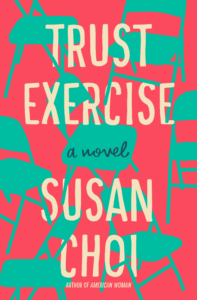

Figure 2. Susan Choi, Trust Exercise (2019), design by Nicolette Seeback. Lauren Groff, Fates and Furies (2015), design by Rodrigo Corral and Adalis Martinez, illustration adapted from artwork engraved and published by Nathaniel Currier.
A related softening of edges and confusion of boundaries can be seen on the cover for Brit Bennett’s The Vanishing Half (2020), where the bold sans-serif font occasionally goes transparent and seems to fade into the brightly colored ground.
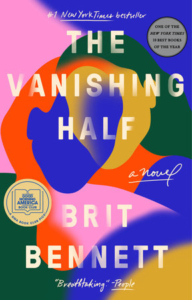
Five flat colors without any internal shading (pink, red, green, gold, cobalt blue) govern distinct areas of the cover, but the hard edges of these zones sometimes blur into softness, as with the blue and pink at the top of the cover, and as we see with the red and the pink to the left of the word “Brit.” At the heart of the design, two silhouettes interlace, so that the gold face of the woman who seems to be in the rear is actually also simultaneously the frontmost plane. The cover courts dissolution, especially in the bottom right corner, which remains baffling to me. A blue diagonal swoop extends the blue zone that seems to denote the gold-faced woman’s shoulder into the front—perhaps her arm is thrown in an embrace around the shoulder of the blue-faced woman? But the swoop also looks so little like an arm that the cover tends toward a more thorough abstraction. This is all, of course, thematically appropriate for a book with the word “vanishing” in the title, for a book about passing and sisterhood. Just as with Shamsie’s book about best friends, here the edge joins even as it demarcates.
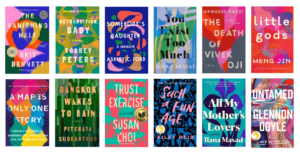
I am hardly the first (or the fourteenth or the fiftieth) person to write about this ubiquitous cover style. To wit: this is another writer’s collage, which headed an article published a year and a half ago with the title “There is a Major Problem With Modern Book Cover Design.”8 Writers vary in how they describe this kind of cover: some point to “blobs of suggestive colors” (Jeva Lange), “stylized drips” (Margaret Boyer-Dry), or “abstract splotches” (R. E. Hawley). Another notes the “neon color palette, sans serif title, ambiguous silhouettes,” and “bright, nebulous style” (Alana Pockros). There is even a mention of “statement wallpaper and fatty text” (Boyer-Dry again). But if we take them as a group, we can see that they’ve noticed the same elements that I’ve flagged in the Shamsie and Bennett covers: bright color and big, obvious text, but also a certain degree of abstraction, nebulousness, blobbiness, splotchiness, ambiguity—all words that point to the importance of soft edges in how these covers operate. And the umbrella category that contains this design has also been anatomized by Mendelsund and Alworth, who add patterning and “the crowding of space” to our list of characteristics and who also use Groff’s Fates and Furies to date the beginning of what they call “the era of the interchangeable, big-type, colorful cover” to 2015.9
Since then, Mendelsund and Alworth argue, along with the other writers I’ve quoted, that this cover design—which is engineered to be “Instagrammable,” and can be called “the ‘it will work well as a thumbnail on Amazon’ cover”10—has come to do genre work. In some ways, that’s not surprising. As Genette noted over 30 years ago, covers commonly include a “genre indication,” and “simply the color of the paper chosen for the cover can strongly indicate a type of book.”11 What’s interesting here is that, for the most part, this cover is reserved for works of literary fiction, which is, as Mark McGurl puts it, “the genre that likes to think of itself as non-generic.”12 Usually, this is literary fiction of a particular kind. As R. E. Hawley observes, these books are “nearly always written by women, often women of color,” often “debut authors.” The books “have literary sensibility” and simultaneously “generate a good deal of buzz and media coverage, [as] likely candidates for an Oprah Book Club nod or a spot on a major literary prize’s shortlist.”13 That prominent National Book Award circle that disrupts the heavily patterned cover for Fates and Furies is no accident, and neither are the GMA Book Club and NYT Notable Books medallions on the cover of The Vanishing Half.
I’m calling this cover type the “Soft Book Look,” in a riff on the publishing nomenclature of the typography-heavy, negative-space-driven “Big Book Look” given to work by famous writers like Zadie Smith.14 Part of what the Soft Book Look does, I think, is to lead readers to expect that something new (a debut novel) or someone “other” (a woman, a person of color, a queer or trans writer) can be encountered on familiar ground, with familiar terms. The prospective reader is offered a smooth transition into a book that has been designed and marketed to appear very much like other books. This cover says, softly, “please look on this book as a readable, laudable work of fiction.”15


Figure 6. The Unicorn Frappuccino, first released by Starbucks in 2017. Torrey Peters, Detransition, Baby (2021), design by Rachel Ake.
To extend this point further, I want to invoke my favorite description for the Soft Book Look, from Alana Pockros, who calls this “the unicorn frappuccino cover, due to its resemblance to Starbucks’ coffeeless drink that went viral back in 2017.”16 Her analysis stops there, and although it may sound strange, I think that Starbucks’ promotional announcement about the Unicorn Frappuccino, Registered Trademark, helps us see how the soft edges of this cover design function in practice. “Once only found in enchanted forests,” the formerly “elusive” unicorn—or “unicorns,” plural—“have been popping up in social media,” and with the Unicorn Frappuccino, Starbucks aimed to “tak[e] the trend to a new level.”18
The sharp edges—dare I say the pointy horn—of the unique blurs into the soft edges of the trend. Mendelsund and Alworth write that the cover “provide[s] edges around the text, thereby framing the reading experience as bounded and discrete.”19 But I don’t think that’s exactly what’s happening here. The similarity and interchangeability of these covers—taken at scale—suggests that the cover no longer functions as an obvious or singular frame. I might even go so far as to say that if, in the visual arts, a “lost edge” is a border that becomes perceptible to a viewer without becoming visible, exactly, then out on the slick surface of the digital sales platform, where the differences between designs are purposefully minimal, the cover might constitute a lost edge, only vaguely perceptible as one clicks from book to book.
Since this cover design is so much like a “blended beverage,” then, let us turn briefly back to what happens when one drinks a Unicorn Frappuccino. The drink starts out “sweet and fruity,” but by turns and stirs and swirls, it goes “tangy and tart.” But the sweetness is more than a “dusting” or a “sprinkle.” There’s so much sweet here (59 grams of sugar in a grande) that the tart (the different, the other, the challenging, the literary) is never more than “pleasantly sour.”20 The sharp edges of the flavor, of the text, have been softened, and by design.

So what, then? What’s wrong with a sweet surplus of unicorns? To explain, I want to return again to Mendelsund and Alworth, who contend that with book covers, “it’s the feeling that matters above all.”21 Book covers “disclose how it feels to inhabit the author’s world.”22 They quote Henry James: “‘feeling is always meaning.’” “The book cover must calibrate feeling,” provide “sensation,” “set the mood.” In short, the cover externalizes a book’s internal dynamics and interior mood. And when a ubiquitous design ensures that so many books look like each other, when unicorns are everywhere, then the Soft Book Look doesn’t just do genre work. It curates the vibes.


Figure 9. Interior design by Kaitlin Spring (@kspring on Instagram), photo courtesy of Kaitlin Spring. Mirrors and tables designed by Sophie Collé, photo courtesy of Sophie Collé.
The vibe curation I have in mind isn’t the gothic sort that Olivia Stowell, Mitch Therieau, and their contributors write so well about in the Dark Academia cluster for Post45: Contemporaries, but a rather sunnier, more pastel aesthetic native to Instagram, TikTok, Gen Z, and summer 2021.25 There’s also a profusion of hard-edged but curvaceous postmodern furniture, often vintage or bespoke, with nods to Memphis Design. Even the descriptors for subcategories of Avant Basic interior design could be applied to book covers: “the wiggle trend,” “the splat aesthetic.”Cara L. Lewis