
As this cluster of ASAP/J illustrates, there has been an international vogue for mermaids in recent decades. In some cases, this has involved the introduction of mermaid themes and themed events to locales with no prior association with the figure (e.g., US locations such as Coney Island, with its annual mermaid parade, or Norfolk, Virginia, with its multiple sculptures) but in others, the association of mermaids with specific locales has been more well-established. This essay analyses the manner in which the traditional symbol of the Polish capital of Warsaw, the syrenka—a mermaid armed with shield and sword (Figures 1a & 1b)—has been developed and deployed in novel manners in the early 21st century. More particularly, it identifies how the image has been vernacularised in a number of contexts that depart from official associations and symbolism and make it a more active and contemporary figure within a Polish state that has enjoyed substantial security and socio-economic development since entering NATO in 1999 and the European Union in 2004. This is not to suggest a direct causal relation between macro-political events and local-level symbolism but rather to explore how uses of the image have been ‘activated’ in changing socio-political contexts.
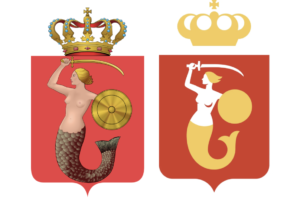
Figures 1a & 1b: Two recent versions of Warsaw’s official symbol. Left: image used in the late 20th and early 21st centuries. Right: simplified logo adopted in 2023.
While elements of her representation and design have changed significantly over time,3 Polish popular culture has also embraced local mermaid traditions in forms such Agnieszka Smoczyńska’s feature film Córki dancingu (released in Anglophone markets as The Lure), which represents two murderous mermaids emerging from the Vistula River into Warsaw’s 1980s’ disco culture. Colourful as Smoczyńska’s re-imagination of the syrenka may be, this essay addresses the more prosaic images available on an everyday basis to the denizens of the city and the skeins of meaning that exist between them and between the historical events they are related to.
One of the more engaging contemporary uses of mermaid symbolism occurs along the cycle-path on Wybrzeże Gdańskie, on the east bank of the Vistula, in the form of a series of signs that variously instruct cyclists to speed up, keep up, slow down and stop at an imminent red light. These messages are conveyed by stylised mermaid figures that appear as variously friendly, neutral or forbidding through the colours they are rendered in and by their emoji like faces. The stop mermaid, for instance (Figure 2a) looks ferocious, rendered in red with her lips turned down and her palms presented to the viewer in a clear stop gesture. There’s nothing in these images that directly reference the syrenka (with her shield and sword), but their location on the banks of the Vistula, close to Ludwika Nitschowa’s famous statue (discussed below) suggests just such an association. The signs were designed by the Warsaw-based Biuro Architektury i Planowania company and were characterised by the company’s deputy director Wojciech Wagner as a “successful combination of functionality and aesthetics,” with Wagner also emphasising that: “Above all, we wanted the symbols to be simple and legible. At the same time we managed to introduce a motif clearly associated with the capital. The animated figure of a mermaid gives the device a uniquely Warsaw character.”5 during the Warsaw Uprising in summer 1944. Between 30,000 and 40,000 residents perished in the area in barbarous circumstances and a total or around 166,000 were killed across Warsaw as a whole, with around 25% of the city being laid to waste as a deliberate punitive measure.6 In this specific geographical context, the image signifies the local massacre and the resilience of the city’s population, but it is also given further relevance/resonance through its location close to the Muzeum Powstania Warszawskiego (Warsaw Uprising Museum) on nearby Przyokopowa street. The impressive museum, which opened in 2004, features an exhibit that overlays the generic syrenka with a human face and story. The museum includes a small display on the life and work of Krystyna Krahelska, a female singer, poet and activist who posed as the model for Nitschowa’s statue in 1936–37. Having given form to one of the city’s iconic images in the years immediately preceding the German invasion, she became a member of the Polish resistance movement, writing a number of popular patriotic songs before being fatally wounded whilst trying to rescue an injured colleague during the uprising. In the museum, on the tram fence mural and elsewhere throughout the city, her story blends with the legend of the syrenka, symbolising Warsaw’s resistance and the power of female patriots to resist invaders. The theme was most vividly articulated by Polish artist Jakub Rozalski in his apocalyptic artwork ‘Mermaid of Warsaw’ (2019) (Figure 5), painted to commemorate the 75th anniversary of the uprising. Using hardcore SF/Fantasy art imagery, a female patriot and Nitschowa’s statue stand alone in a devastated landscape, defying the attentions of a huge, zombie-like, Nazi soldier looming over them.
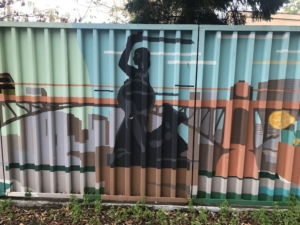
Figure 4. Mural on Siedmiogrodzka street (author’s photo 2022).

Figure 5. Jakub Rozalskiin’s ‘Mermaid of Warsaw’ (2019) (reproduced by permission).
But the syrenka has not just been deployed to evoke solemn historical memory, in recent years there have been attempts to modify her for lighter purposes. In 2004, for instance, Warsaw’s Tourism Office adopted a stylised interpretation of the classic image as its logo and featured it in its 2006 “Zakochaj się w Warszawie” (“Fall in love with/in Warsaw”) campaign. The figure was simply rendered with key lines and colour blocks, with her hair, breasts and tail evident but with the two other elements of the established design more awkwardly modified.10 Despite these responses, the symbolic protest rapidly developed online, with Andrew Stroehlein, European media director of Human Rights Watch, posting gifs of Ariel, the little mermaid from Disney’s animated feature film, with captions such as “mermaid statue comes to life to release statement to press saying that she is not insulted by protestors but by police actions” and ‘Why can’t the Polish authorities just believe in equality?”13
This short analysis of the deployment of syrenka images in early 21st century Warsaw has identified the manner in which the symbol is actively in play and subject to multiple and shifting inflections as the city and Polish society more generally negotiate changes to traditional social, political, and moral-religious worldviews within the context of their membership of the European Union. The syrenka is both a carefully managed metropolitan emblem and a symbol of factional interests within the city’s broader population. Its ability to be deployed in support of various causes and ideological positions demonstrates the mermaid’s polyvalency, being strikingly familiar but ambiguous with regard to precise meanings and associations. Mermaids have been deployed by LGBTQ+ activists and advocate groups internationally (such as the British Trans support organisation known as Mermaids14) but can also serve deep-seated conservative interests through their status as civic symbols in cities such as Warsaw. This plurality confirms the mermaid’s slipperiness as a symbol, its ability to swim through discourse, and to serve various human causes as it remains distinct from them.
: :
Acknowledgements: Thanks to Amelia Coyle-Hayward and Rosa Coyle-Hayward for their assistance in field research for this project in October 2022 and to Tomasz Dobrogoszcz, Dorota Filipczak, Tomasz Fisiak, and Agata Handley for facilitating my travel to Poland and giving their feedback on an earlier draft of this article.
: :
This is part of the cluster Our Mermaid Craze. Read the other posts here.
: :
Endnotes
- https://shimajournal.org/issues/v12n2/m.-Wasilewski-Kostrzewa-Shima-v12n2.pdf
- https://shimajournal.org/issues/v12n2/m.-Wasilewski-Kostrzewa-Shima-v12n2.pdf
- Hayward, P. (2017) Making a splash: representations of mermaids (and mermen) in 20th and early 21st century audiovisual media. John Libbey & Co./University of Indian Press
- https://pl.yunextraffic.com/en/references/new-technology-for-cyclists-in-warsaw/
- Which also included eastern Europeans troops serving in the Kaminski brigade and Azerbaijani Legion.
- Hanson, J.K.M. (1982). The civilian population and the Warsaw Uprising of 1944. Cambridge University Press.
- https://um.warszawa.pl/waw/markawarszawa/-/zakochaj-sie-w-warszawie-historia-znaku
- https://www.dziendobrywarszawo.pl/what-to-see-warsaw/
- https://twitter.com/Policja_KSP/status/1290647051995435008
- https://www.politico.eu/article/polish-police-crack-down-on-lgbtq-protesters/
- https://twitter.com/astroehlein/status/1290915582968201217
- https://www.reddit.com/r/warsaw/comments/iad95q/lgbt_mermaid_mural_in_warsaw/?rdt=58423
- https://www.reddit.com/r/warsaw/comments/iad95q/lgbt_mermaid_mural_in_warsaw/
- https://mermaidsuk.org.uk

Philip Hayward