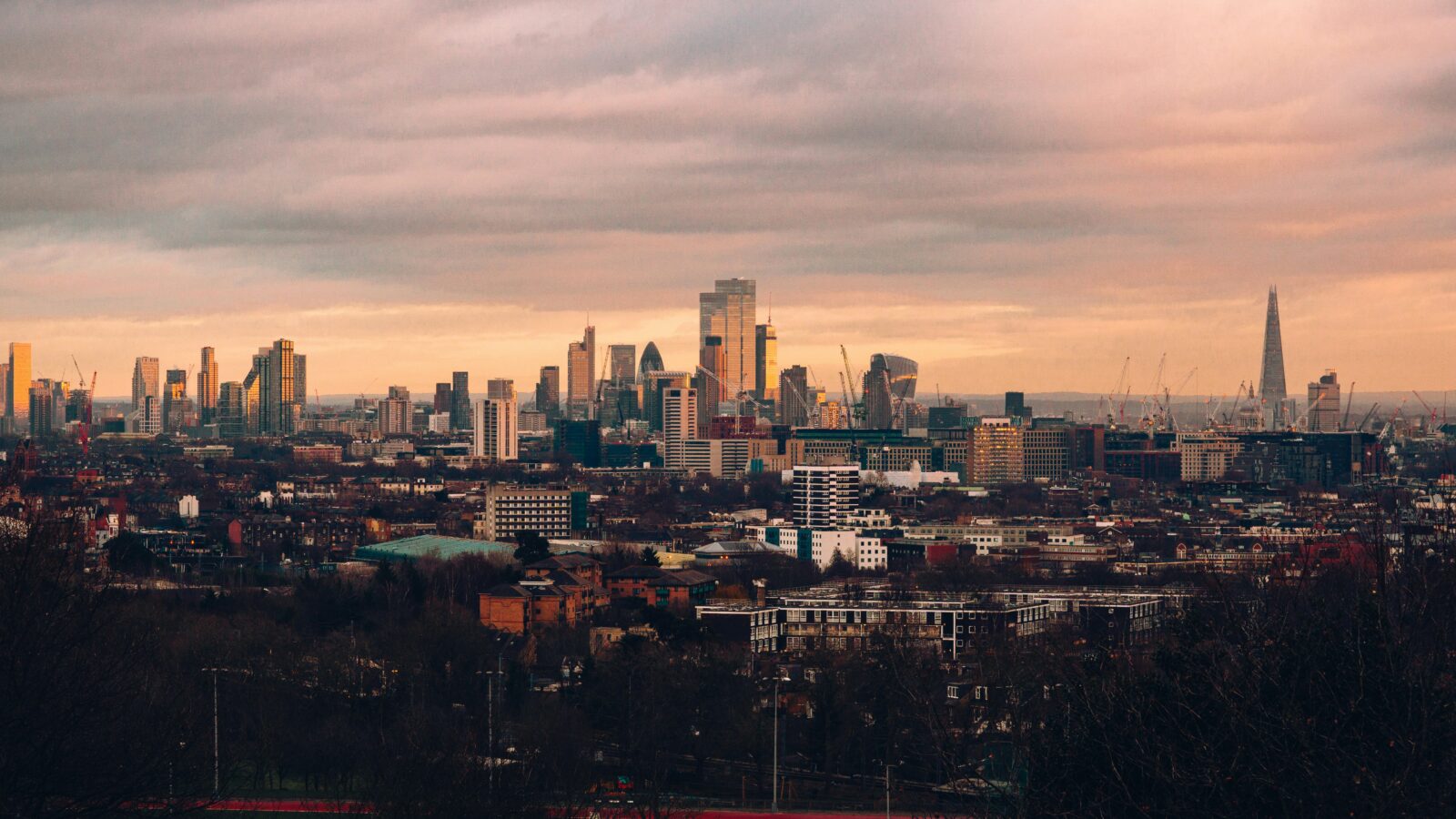
Two haunted buildings organize Andrew Haigh’s 2023 film All of Us Strangers: the first is a nearly empty tower block on the edge of London; the other, a suburban home in Sanderstead, Croydon. The former is filmed in moody long shots that emphasize its emptiness, two lonely apartment buildings side by side. The view from inside shows the London skyline far in the distance, marking the apartment as urban, yet remote, far from the bustling liveliness of the city, and the company of other people.2 To refuse to reproduce the family—through marriage, through children—is to refuse a position of centrality within it, to refuse a space inside the home.
The refusal of the family is also temporal refusal, a refusal of the form of temporal regulation that Elizabeth Freeman calls “chrononormativity”: “the use of time to organize individual human bodies toward maximum productivity.”3 Counter to this chrononormativity which regulates, among other things, the temporal presumption that children will eventually grow up, move to the suburbs, start their own families, is the temporal mode of what Freeman, Jack Halberstam, and others have called “queer time,” in which the diminishing sense of the future in the wake of the AIDS epidemic, as well as a detachment from the generational logics of reproduction and inheritance, produce alternative temporalities for queer life—a heightened emphasis on the present, as well as possibilities for other kinds of futures. “The constantly diminishing future,” Halberstam writes, “creates a new emphasis on the here, the present, the now.”4
When it isn’t being haunted by an unreachable past, All of Us Strangers lives within this very same suspended present, a perpetual moment of now-ness, emphasized by the film’s pacing, which stretches small moments out into long and languid meditations. Long takes and a static camera create the feeling that time, especially in Adam’s apartment, can stretch on endlessly in the present moment, never quite reaching the next, or finding a foothold in the future.
And yet, here queer time does not hold quite the same utopian force as it once might have. “I’d always felt lonely, even before,” Adam tells Harry, recounting the day his parents died. “This was a new feeling, like a . . . terror, that I’d always be alone now . . . Losing them, it just got tangled with all the other stuff, about being gay and . . . just a feeling like the future doesn’t matter.” Rooted both in Adam’s particularity as a gay man who grew up amidst the trauma of the AIDS epidemic, and in Haigh’s own experience as a gay man of that same generation,6
As Adam and Harry go out dancing at the Royal Vauxhall Tavern, time ceases to have meaning. Together in a bathroom stall, the two take ketamine, and, underscored by Blur’s “Death Of A Party,” the film slips from a dreamy set of dissolves in the night club; to a montage of mundane, domestic scenes in Adam’s apartment—Harry cooking breakfast, Adam working on his script while Harry reads Walden across the room, the two lying on the couch eating pizza and watching music videos, brushing their teeth after a shower; back to the nightclub, as Adam walks through the window of his own bedroom and onto the dance floor; until finally, he wakes up in the bed of his childhood home, feverish, and walks downstairs to find his parents decorating the Christmas tree.
“Is this real?” he asks his mother, as she tucks him into bed. She answers: “Does it feel real?” And though these sequences are framed within a nightmare framed within a k-hole, her question is key to understanding how haunting’s disruptions also offer something to Adam that promises an escape from the melancholic tangle of incompatibilities and incompossibilities. This moment, of being in his childhood bed again is not real; the future he fantasizes about with Harry isn’t, either. But neither are any of the conversations he has had with his parents or Harry, conversations he has had with ghosts. Nevertheless, they feel real. Though the temporalities they take place in are segmented off as less than real, as altered states and fantasies, their impact is nevertheless profoundly felt.
Almost a quarter of the film’s run-time is captured inside this dissociative k-time, between the moment Adam takes ketamine in the bathroom of the nightclub and when he wakes up with Harry the next morning. In this space, Adam is able to imagine a future—even a future as nearby as “tomorrow”—with Harry. But even that hopeful imagining is cut short by images of horror: he imagines Harry dancing with another man in the night club; he finds himself lost and disoriented, chasing Harry’s image on the Underground; when he eventually finds himself, wearing his ill-fitting childhood pajamas, in bed with his mother, and tells her about the future he imagined with her, and all the places they would have gone together if she hadn’t died, Harry’s intrusion into the scene heralds yet another impossibility of that future, as his appearance is accompanied by the blue flashing lights of police sirens outside. An omen of death, the specter of Harry carries with it the reminder of the precise moment Adam lost his family, the knock of police at the door.
Normative temporalities are incapable of capturing the full spectrum of Adam’s need to grapple with what it means to have lost a future before he even knew to want it—to have lost access to the ability to imagine a future when he lost his parents, when he realized he was gay. So, too, are the normative architectures that cover the spectrum of what we might call home: the family home, a place which carries with it the burden of generations of inherited expectation, and the urban apartment, a place of alienation and loneliness.
Instead, All of Us Strangers offers what we might, after “queer time” and “k-time,” call a “haunting time,” a temporal framework which not only blurs our readily-held associations with and distinctions between past, present, and future, but altogether escapes them.
At the end of the film, Adam and Harry lie in bed together, holding one another. As the overhead camera zooms out around them, it does not reveal Adam’s bedroom, or the space of his apartment, but instead a vast void of darkness around them. At the center of this dark space, the two of them are alone—until, in the film’s final moments, they are transformed into a single point of light, a single star in the night sky, which is soon joined by dozens of other points of light, a constellation of connection that cuts through the loneliness. Outside of space, outside of time, the hauntings of All of Us Strangers offer a glimpse into something beyond these temporalities and architectures, a possibility of other ways of moving through the world.
: :
Endnotes
- Haigh explains in an interview that the soundstage set for the apartment “had big LED panels with the outside of London projected on them” to create the view of the city. “Director of photography Jamie Ramsey was able to do something slightly different with the focus—the deep background outside is more in focus than it ever would be if you were shooting in a real apartment.” The city remains a constant focal point of the apartment: both its proximity and its distance. Neil Smith, “Andrew Haigh breaks down four key scenes from All of Us Strangers: ‘Half the crew were crying,” ScreenDaily, February 5, 2024. https://www.screendaily.com/features/andrew-haigh-breaks-down-four-key-scenes-from-all-of-us-strangers-half-the-crew-were-crying/5190183.article.
- Sara Ahmed argues that the family is a point of inheritance, meant to be reproduced by those who inherit it. If happiness “involves a way of being aligned with others, of facing the right way,” the queer child who fails or refuses to reproduce the “happy family,” refuses that orientation, that alignment. See: Sara Ahmed, The Promise of Happiness (Duke University Press, 2010), 45.
- Elizabeth Freeman, Time Binds: Queer Temporalities, Queer Histories, (Duke University Press, 2010), 3.
- Jack Halberstam, In a Queer Time and Place: Transgender Bodies, Subcultural Lives (NYU Press, 2005), 13.
- In an interview with The Guardian, Haigh expresses having felt the same bleak impossibility of a future that Adam vocalizes in the film: “It wasn’t an easy time. Growing up, I felt, ‘If I’m going to become a gay person I’m not going to have a future, and the only other alternative is not to be gay’ – which of course you can’t not be.” Alex Needham, “‘A generation of queer people are grieving for the childhood they never had’: Andrew Haigh on All of Us Strangers,” The Guardian, December 29, 2023. https://www.theguardian.com/film/2023/dec/29/a-generation-of-queer-people-are-grieving-for-the-childhood-they-never-had-andrew-haigh-on-all-of-us-strangers.
- McKenzie Wark, Raving (Duke University Press, 2023), 92.
Christine Prevas